Author: Eric Holmberg

  • When Scripture seems to contradict itself.

    When Scripture seems to contradict itself.

    Among the most popular verses skeptics love to point out are the very different versions in the Gospels regarding one of the most important–one could argue THE most important–accounts in all of scripture: Easter morning and the empty tomb.

    I’ve taken the best scholarship on the subject and added a little imaginative speculation. But the bottomline is simple: Ancient writers did not aim at modern, synchronized chronology. They highlighted representative figures, condensed timelines, omitted intermediate steps.

    John explicitly narrows in on Mary Magdalene’s interior experience.

    Matthew emphasizes corporate witness and fulfillment motifs.

    BEFORE DAWN, while the city still slept under the weight of the crucifixion, a small group of women made their way to the tomb—Mary Magdalene, Mary the mother of James, Salome, Joanna, and others. They came not expecting resurrection, but to finish the work of burial. Their grief was practical, embodied: spices in hand, questions on their lips—Who will roll away the stone?

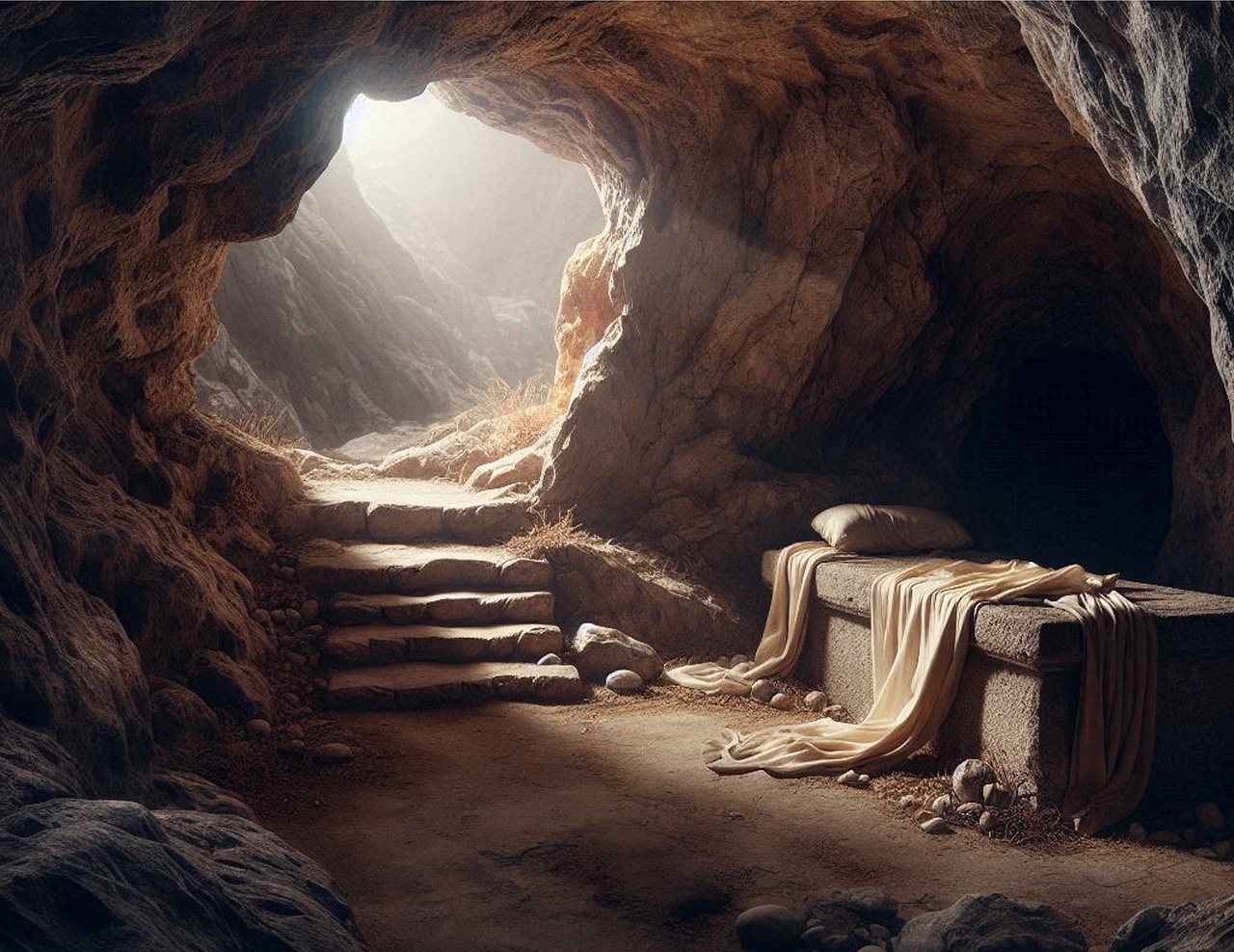
    But the stone was already moved. The earth itself had trembled. An angel of the Lord had descended, and now the tomb stood open—not to let Jesus out, but to let witnesses in.

    They entered and saw that He was not there.

    “Do not be afraid,” the angel said. “He is risen.”

    What? Grief began to give way to hope, excitement, and confusion. So much to process, too sudden to comprehend. And in that moment, a decision was made. Mary (the Magdalene), you go tell Peter and John. We’ll go to where the other disciples are staying.

    Mary ran, still processing the angelic message. Her mind had not yet caught up to resurrection; all she knew was absence. They have taken the Lord… and we do not know where they have laid Him.

    The other women took a different route, hurrying, excited to tell the other nine what they had just seen and heard.

    And as they journeyed, Jesus met them.

    Not as an idea. Not as a memory. Alive.

    They fell at His feet. They grasped Him. The crucified One stood before them, tangible, undeniable. Their fear gave way to worship.

    Meanwhile, Peter and John, having heard Mary’s report, rushed to the tomb. She did her best to keep up with them. John, younger and faster, got there first, but then stopped, giving the leader of the the new apostolic band the honor of being the first to enter the open tomb. There they saw the two angels, one at the head, the other at the foot of the stone slab on which Jesus’ body and been laid**. There were the linen shroud in which He has been wrapped**** along with the face cloth, which had been on Jesus’ head, not lying with the linen cloths but folded up in a place by itself. The order of it all—no sign of theft, no trace of violence. And yet, they did not yet understand. They left.

    Mary did not.

    She returned, slower now. The urgency had drained into sorrow. The others had seen something—perhaps even Him—but she had missed it. The one who had been delivered from the kingdom of darkness now stood again at the edge of it, staring into an empty tomb.

    She wept.

    Two angels spoke, but even this did not break through. Grief has a way of dulling even the supernatural. Then she turned—and saw a man.

    A gardener, she thought.

    Of course a gardener. Who else would be here, tending the place of death?

    “Sir, if you have carried Him away…”

    She is still trying to solve the problem at the level of loss. Still assuming Jesus belongs to the realm of the dead.

    Then He speaks her name.

    “Mary.”

    And everything collapses—the grief, the confusion, the frantic explanations. Recognition does not come through sight, but through being known. The Shepherd calls His sheep, and she hears Him.

    “Rabboni.”

    **Later, it was Peter who connected the dots. Mercy seat. (Exodus 25:18-20)

    *** Reconciling this account with the Shroud of Turin: Jewish burial customs in the first century commonly included a large linen sheet wrapping the entire body. Additional bindings or strips were added to keep everything in place while the body decomposed, including a separate head covering. The shroud was main wrapping that was first applied.
  • What’s up with the 153 fish that were in the net that Peter drags to shore (John 21:11)?

    What’s up with the 153 fish that were in the net that Peter drags to shore (John 21:11)?

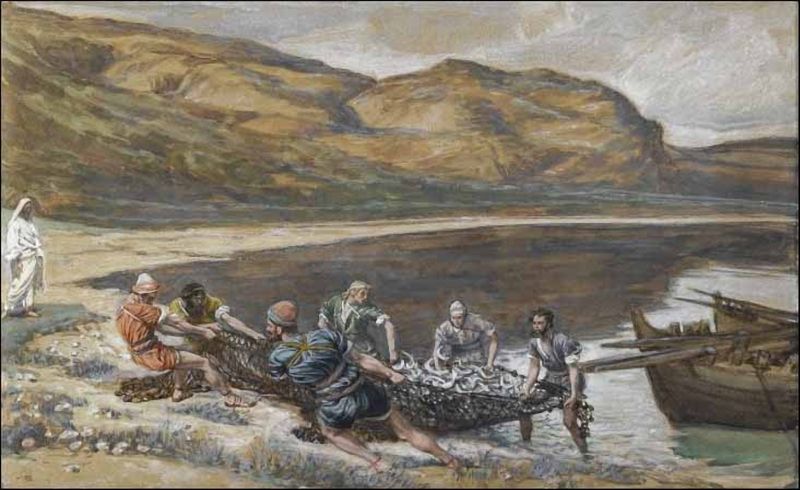
    (From the Gospel reading, John 21:1-14) The number 153 fish has fascinated interpreters from the earliest centuries. The Fathers—and later commentators—almost universally assume the number is intentional, not incidental. What varies is why.

    Here are the most influential and intellectually interesting interpretations:

    Augustine of Hippo — The “Fullness of the Law and Grace”

    Augustine offers the most mathematically elaborate interpretation.

    He notes that 153 is the triangular number of 17:

    1 + 2 + 3 + … + 17 = 153

    Then he interprets 17 symbolically:

    10 = the Law (Ten Commandments)

    7 = the Spirit (sevenfold gifts, cf. Isaiah 11)

    CONCLUSION: 153 represents the totality of those saved—the Church as the fulfillment of Law and Grace.

    Jerome — The “All Nations” Theory

    Jerome draws on ancient zoological knowledge: Greek naturalists (he claims) identified 153 species of fish.Therefore, the catch symbolizes every kind of human being. (“They say there are 153 kinds of fish… signifying all nations.” (Jerome’s Commentary on Ezekiel)

    CONCLUSION: The number represents the universality of the Gospel mission—all nations gathered into one net (the Church).

    This interpretation became extremely influential because it aligns neatly with: Matthew 28:19 (“make disciples of all nations”) and the Church as catholic (universal)

    Cyril of Alexandria — The Mission After the Resurrection

    Cyril is less numerically speculative but still symbolic: The large number reflects the abundance of apostolic success and the unbroken net shows unity despite diversity

    The emphasis is less on decoding 153 mathematically and more on what it represents: The apostles will gather a great multitude “of every sort” into one Church.

    CONCLUSION: 153 = fullness and abundance, tied to the post-resurrection mission.

    Thomas Aquinas — Synthesis of Earlier Views

    Aquinas doesn’t invent a new theory but gathers prior ones:

    Accepts Augustine’s 17-based symbolism

    Notes Jerome’s universality of species

    Emphasizes that Scripture often uses numbers figuratively but meaningfully

    CONCLUSION: The number carries multiple layers—mathematical, theological, and ecclesial.

  • Two Questions for my Protestant Friends on Mary, The Mother of God

    Two Questions for my Protestant Friends on Mary, The Mother of God

    In early Christianity the relics of saints (Peter, Paul, martyrs, etc.) and their tombs (if they were buried) were carefully preserved and venerated. No matter what you think about this practice–and you may want to give it some thought–it is a matter of historic record.

    But there is a complete absence of Marian relics. How would you explain this?

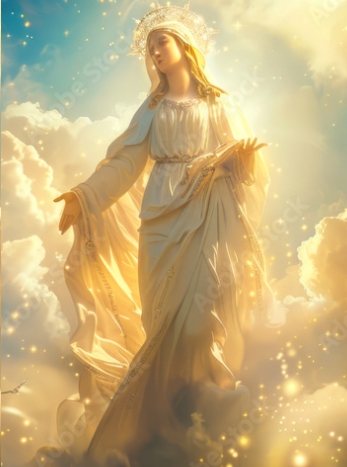
    “And a great sign appeared in heaven: a woman clothed with the sun, with the moon under her feet, and on her head a crown of twelve stars. She was pregnant and was crying out in birth pains and the agony of giving birth. And another sign appeared in heaven: behold, a great red dragon, with seven heads and ten horns, and on his heads seven diadems. His tail swept down a third of the stars of heaven and cast them to the earth. And the dragon stood before the woman who was about to give birth, so that when she bore her child he might devour it. She gave birth to a male child, one who is to rule all the nations with a rod of iron, but her child was caught up to God and to his throne,” Revelation 12:1-5

    Most Protestant scholars believe that this passage–specifically the woman and the twelve stars refers to both the Old Testament ecclesia and the 12 tribes of the New Testament ecclesia and the twelve apostles. Catholic scholars agree, but also add Mary as another subject of this passage. If you don’t think that is true or at least a possibility, why?***

    ** “It is the glory of man to search out a matter.” (Proverbs 25:2b) I learned a long time ago an important key in discerning truth: Acknowledge that I don’t know what I don’t know. And to then beware of rejecting things reflexively because the “tribe” (hivemind) I inhabit (we all do whether you like it or not) has taught me certain presuppositions and “facts” that predispose in me a bias (sometimes unconscious) against certain truths that other Christians accept.

    *** You would do well to reflect on “His tail swept down a third of the stars of heaven and cast them to the earth.” When did that happen?

  • Have you been infected?

    Have you been infected?

    I have a minister friend who I have never met but have interacted with for many years over his bold stance—bolstered by an important book he authored—against the normalization of homosexuality around the world. He seemed fearless and willing to take the heat, a true Gideon, immune from the slop that courses down the sluices built by the “New Model Army Corp of Engineers” that are high jacking America.

    So I was taken aback when he posted this on his FaceBook account:

    “This truth deserves frequent repetition in today’s climate of mindless Anti-Zionism. “Zionism” is merely the belief that the House of Judah has a covenantal right to the Holy Land granted by God to Abraham and his descendants. Bible literalism affirms this right, which Gal 3:15-17 and Romans 11:25-29 confirm is not revocable nor merit-based like the Mosaic Law is/was.”

    I responded: “I agree with your definition of Zionism. Couldn’t disagree more that it is supported by scripture.”

    He responded: “Gal 3:15-17 and Romans 11:25-29: simple biblical “math.””

    I then responded: “Using New (Darby/Scofield) Math, yes. Old, classical mathematics, absolutely not.”

    And then, to quote the poet, “I felt the earth move underneath my feet” and hammered out a full-throated response:

    You do realize, Scott, that for roughly 1,850 years the vast majority of Christian scholars—Catholic, Orthodox, and Protestant alike—understood that the only remaining promise concerning natural Israel was a future spiritual revival before Christ returns to close the scroll on this world, when many Jews would come to faith in Him.

    As for every other promise—including the land grant—it was understood to belong to the true seed of Abraham: the Church. And the land? Not a narrow strip of territory in the Middle East, but ultimately the whole world.

    Because of a theological thought virus that has infected you and millions of other well-meaning evangelical Christians, the world now finds itself in a very dangerous place.

    The virus was manufactured in England by John Nelson Darby in the late 1820s and early 1830s, cultured in the laboratory of Plymouth Brethrenism, and then carried across the Atlantic when Darby conducted multiple preaching tours in America between 1862 and 1877—an environment already fertile soil for religious innovation, eccentric sects due to the distinctly Protestant assumption that “my private interpretation of Scripture is just as valid as yours.”

    Once here, the virus found its super-spreaders: the Scofield Study Bible (1909–early 1950s); Dallas Theological Seminary (mid-1920s through the late 1960s); Lewis Sperry Chafer’s Systematic Theology (1947–48); Hal Lindsey’s The Late Great Planet Earth (1970); The Ryrie Study Bible (1978); and, eventually, the Left Behind novels (1995–2007).

    And the result?

    A large segment of American Christianity now reads the Middle East through a prophetic script written not even two centuries ago, unheard of for over 1,800 years. And ironically that script has helped draw the United States into conflict in the very region where those false prophetic expectations are supposed to unfold—all at the behest of natural Israel, no less.

    If Shakespeare were writing tragedies today, he could scarcely ask for a more darkly ironic plot: a theological theory conceived in Victorian England helping to steer modern superpowers toward a war that could spiral into a global catastrophe, complete with nuclear weapons.

    Don’t believe me? According to recent reporting, a watchdog organization (Military Religious Freedom Foundation (MRFF)) has received more than 200 complaints from U.S. service members alleging that some commanders have framed the war with Iran in explicitly biblical “end-times” language: briefings where officers told troops that the conflict was: “all part of God’s divine plan”, “connected to Armageddon”, and related to the “imminent return of Jesus Christ.” One complaint from a non-commissioned officer said a commander referenced the Book of Revelation and told troops the conflict could trigger the biblical end times. Another allegation claimed a commander said that the president had been “anointed by Jesus to light the signal fire in Iran to cause Armageddon.”

    Iran knows they’re in a literal fight for their survival. They understand that Israel wants their Islamic regime wiped off the face of the earth. And America, Israel’s lap dog, has joined them. (Read Rubio’s comment to reporters on March 2, 2026, one he tried to walk back the next day.) Whatever demonic ideologies waft through the turbaned heads of their “velayat-e faqih”-led government, and there are many (don’t try to write-off what I’m saying by labeling me an apologist for Islam, Jihad, etc.; I’m not), Iran is well within their right to resist Israel and America’s satanic support of homosexuality, abortion, gender confusion, human sex-trafficking (Epsteinology), the seizure of Palestinians lands coupled with ethnic cleansing; and an Imperial America that thinks it has some kind of divine mandate to meddle in other country’s’ internal affairs and tell them what they MUST do or we seriously mess you up. And as true believers, many people in Iran—proud heirs and guardians of a civilization of immense antiquity, one whose kings ruled the known world and whose culture flourished thousands of years before America was even a glimmer in history’s eye—are more than ready, due in some cases to their own equally flawed eschatology, to light up Israel and every other Arab nation that—because of their compromising love of personal peace and affluence—are in bed with America (housing military bases, loosening moral standards, etc.).

    And a number of other powerful nations like Russia, Turkey, and even China who share similar tradition-based values coupled with a fear of American imperialism may jump in as well.

    “Desperatio facit audacem.” (“Desperation makes men bold.” Tacitus

    “Do not press a desperate foe too hard.” Sun Tzu, “The Art of War.”

    We shall see. Trump/Hegseth may haven’t gotten supremely lucky and taken out enough of Iran’s defense (and let me emphasize that they are more defensive than offensive) capabilities to neutralize any blowback that could lead to WWIII. (Google the “Samson Option”) .

    And maybe not.