Among the most popular verses skeptics love to point out are the very different versions in the Gospels regarding one of the most important–one could argue THE most important–accounts in all of scripture: Easter morning and the empty tomb.
I’ve taken the best scholarship on the subject and added a little imaginative speculation. But the bottomline is simple: Ancient writers did not aim at modern, synchronized chronology. They highlighted representative figures, condensed timelines, omitted intermediate steps.
John explicitly narrows in on Mary Magdalene’s interior experience.
Matthew emphasizes corporate witness and fulfillment motifs.
BEFORE DAWN, while the city still slept under the weight of the crucifixion, a small group of women made their way to the tomb—Mary Magdalene, Mary the mother of James, Salome, Joanna, and others. They came not expecting resurrection, but to finish the work of burial. Their grief was practical, embodied: spices in hand, questions on their lips—Who will roll away the stone?
But the stone was already moved. The earth itself had trembled. An angel of the Lord had descended, and now the tomb stood open—not to let Jesus out, but to let witnesses in.
They entered and saw that He was not there.
“Do not be afraid,” the angel said. “He is risen.”
What? Grief began to give way to hope, excitement, and confusion. So much to process, too sudden to comprehend. And in that moment, a decision was made. Mary (the Magdalene), you go tell Peter and John. We’ll go to where the other disciples are staying.
Mary ran, still processing the angelic message. Her mind had not yet caught up to resurrection; all she knew was absence. They have taken the Lord… and we do not know where they have laid Him.
The other women took a different route, hurrying, excited to tell the other nine what they had just seen and heard.
And as they journeyed, Jesus met them.
Not as an idea. Not as a memory. Alive.
They fell at His feet. They grasped Him. The crucified One stood before them, tangible, undeniable. Their fear gave way to worship.
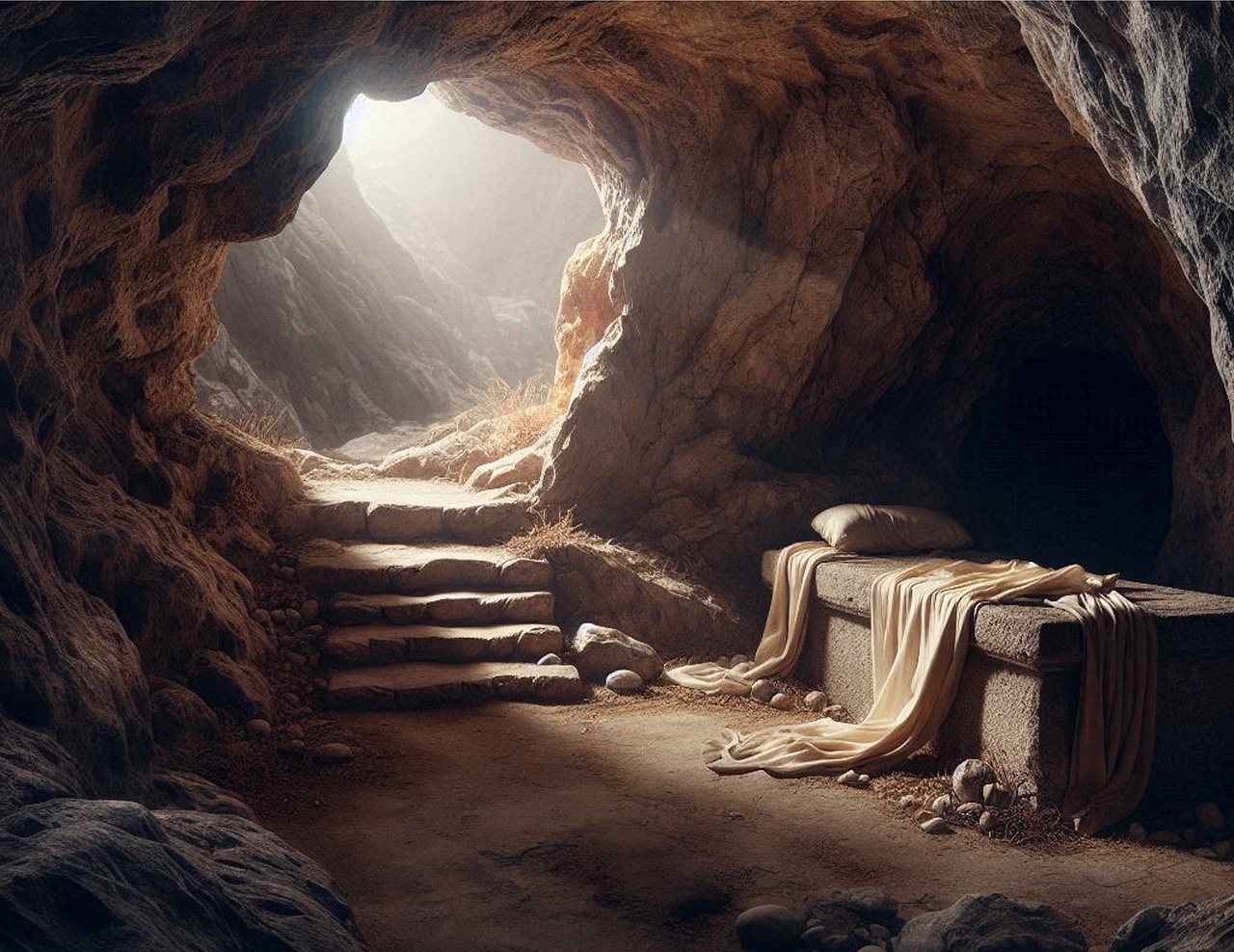
Meanwhile, Peter and John, having heard Mary’s report, rushed to the tomb. She did her best to keep up with them. John, younger and faster, got there first, but then stopped, giving the leader of the the new apostolic band the honor of being the first to enter the open tomb. There they saw the two angels, one at the head, the other at the foot of the stone slab on which Jesus’ body and been laid**. There were the linen shroud in which He has been wrapped**** along with the face cloth, which had been on Jesus’ head, not lying with the linen cloths but folded up in a place by itself. The order of it all—no sign of theft, no trace of violence. And yet, they did not yet understand. They left.
Mary did not.
She returned, slower now. The urgency had drained into sorrow. The others had seen something—perhaps even Him—but she had missed it. The one who had been delivered from the kingdom of darkness now stood again at the edge of it, staring into an empty tomb.
She wept.
Two angels spoke, but even this did not break through. Grief has a way of dulling even the supernatural. Then she turned—and saw a man.
A gardener, she thought.
Of course a gardener. Who else would be here, tending the place of death?
“Sir, if you have carried Him away…”
She is still trying to solve the problem at the level of loss. Still assuming Jesus belongs to the realm of the dead.
Then He speaks her name.
“Mary.”
And everything collapses—the grief, the confusion, the frantic explanations. Recognition does not come through sight, but through being known. The Shepherd calls His sheep, and she hears Him.
“Rabboni.”
**Later, it was Peter who connected the dots. Mercy seat. (Exodus 25:18-20)
*** Reconciling this account with the Shroud of Turin: Jewish burial customs in the first century commonly included a large linen sheet wrapping the entire body. Additional bindings or strips were added to keep everything in place while the body decomposed, including a separate head covering. The shroud was main wrapping that was first applied.